

An emcee script is the document that tells the host what to say and when: the welcome, housekeeping, speaker introductions, transitions between sessions and the close. Good scripts are short on paper and leave room for the emcee to sound like a person rather than someone reading.
Short answer: build the script on top of the run of show, one block per agenda item. Each block needs the time, who is on stage, the exact words that must be said (names, titles, sponsor lines, safety notes) and a cue for what happens next. Write introductions in full, keep everything else as bullet points, and expect the script to change on the day.
Run of show vs emcee script
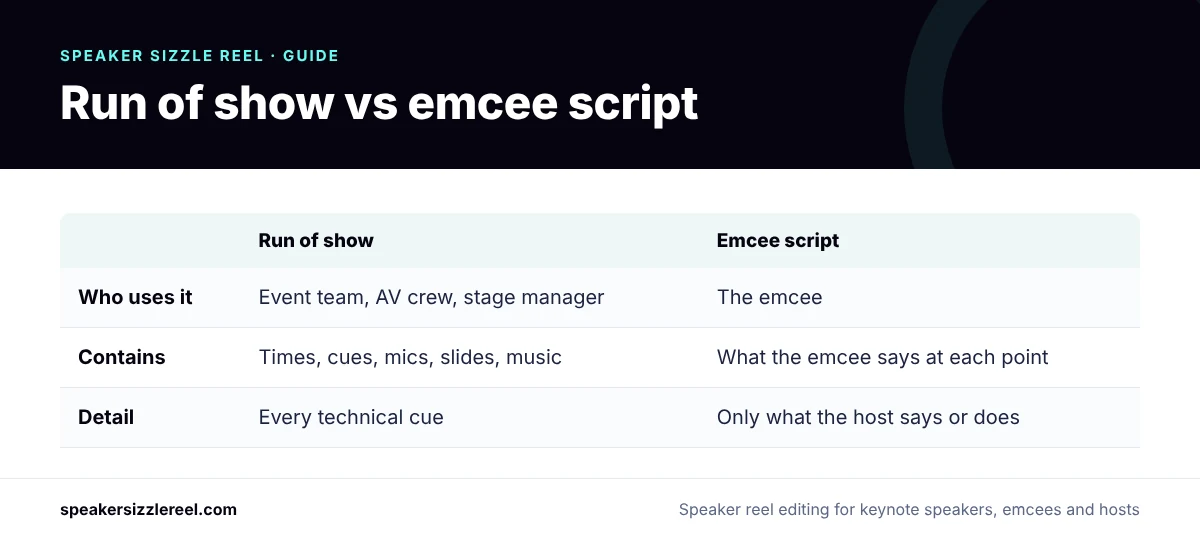
| Run of show | Emcee script | |
|---|---|---|
| Who uses it | Event team, AV crew, stage manager | The emcee |
| What it contains | Times, cues, mics, slides, walk-on music | What the emcee says at each point |
| Level of detail | Every technical cue | Only what the host needs to say or do |
The two must match. If the run of show changes, the script changes with it, so keep both in the same shared folder and date each version.
The sections of a conference emcee script
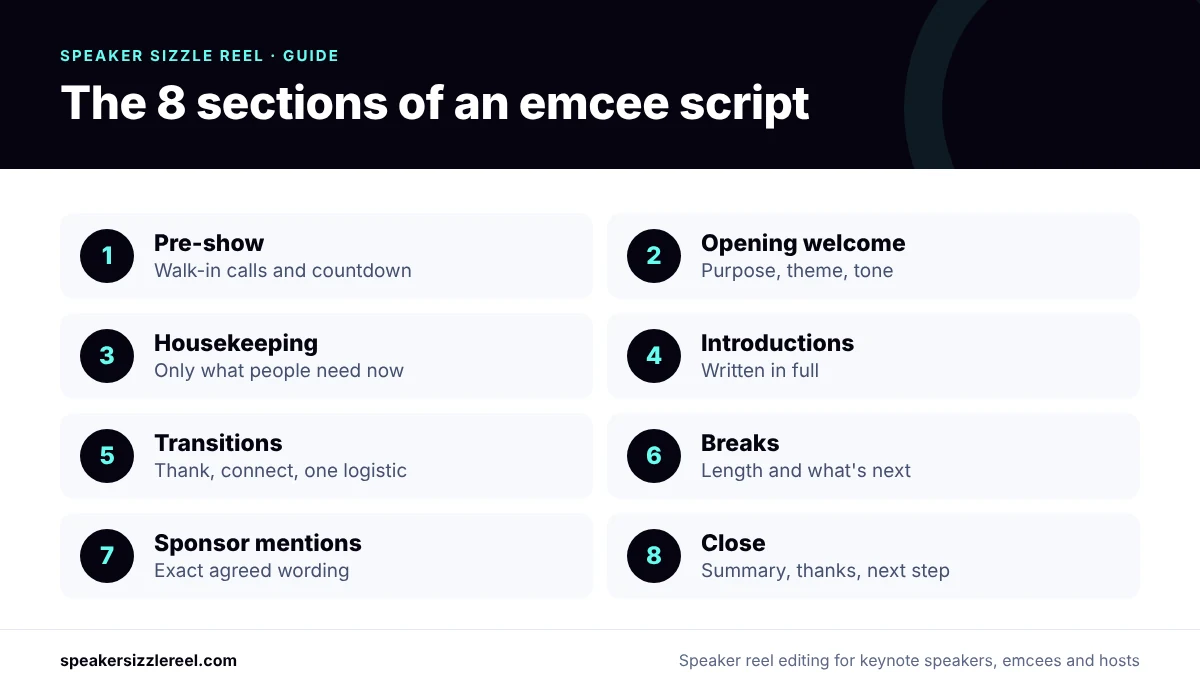
- Pre-show. Walk-in announcements, the “please take your seats” call and any countdown.
- Opening welcome. Who you are, why the audience is here, the theme of the event and one line that sets the tone.
- Housekeeping. Wi-fi, exits, phones, the app, where lunch is. Keep it to what people need right now; the rest can go in the app or on a slide.
- Speaker introductions. Written in full for each speaker (see below).
- Transitions. A short bridge out of each session: thank the speaker, connect their idea to what comes next, give one piece of logistics.
- Breaks and returns. How long the break is and what happens when people come back.
- Sponsor and partner mentions. Exact wording, agreed with the event team in advance.
- Close. A summary of the day, thanks, the next step for attendees and the final logistics.
Writing speaker introductions
Introductions are the one part of an emcee script worth writing word for word, because names, titles and credentials must be right. Speakers bureau BigSpeak suggests about thirty seconds is enough, built around four questions: what the topic is, why it matters to this audience, why the speaker is an expert, and who the speaker is. Ask every speaker for their preferred introduction and the pronunciation of their name, then trim it to fit.
“In the next forty minutes we’re going to talk about [topic], which matters to everyone here because [reason]. Our speaker has [credential that matters to this audience]. Please welcome [name].”
A sample block from a script
| Time | On stage | Emcee says / does | Next cue |
|---|---|---|---|
| 10:30 | Emcee | Thank previous speaker by name. One-line link to next session. Remind audience about the Q&A app. | Slide: next speaker title |
| 10:32 | Emcee | Read introduction (30 seconds). Lead applause. | Walk-on music, speaker enters stage left |
| 11:15 | Speaker | Emcee stands by side of stage to manage Q&A if time allows. | Five-minute warning card at 11:10 |
What to leave out of the script

- Jokes written by someone else. Let the emcee bring their own humor, agreed in tone with the organizer.
- Long bios. They’re in the program. The introduction only needs what makes the audience want to listen.
- Every word of every transition. Bullet points give the emcee room to react to what just happened on stage, which is what makes a host feel present.
Keep a copy for your reel
If you host regularly, your scripts are also a map of your best footage. Note the timestamps of strong openings, introductions and recoveries while the day is fresh, and ask the AV team for the recording. Those moments are exactly what an emcee demo reel is built from.
Common questions
Who writes the emcee script?
Usually the event team drafts it from the run of show, and the emcee edits it into their own words. Experienced emcees often offer script writing as part of their fee.
How long should the opening welcome be?
Two to three minutes is enough for most conferences: welcome, purpose, tone and the most important logistics. Anything longer delays the first speaker.
Should the emcee memorize the script?
Know the opening and the introductions well enough to look at the audience while delivering them. The rest can stay on cards or a confidence monitor.
Turn your hosting into bookings
If you have recordings of events you’ve hosted, we can turn them into an emcee and host reel that shows planners how you run a room. Send us the links for a free review.
Leave a Reply